
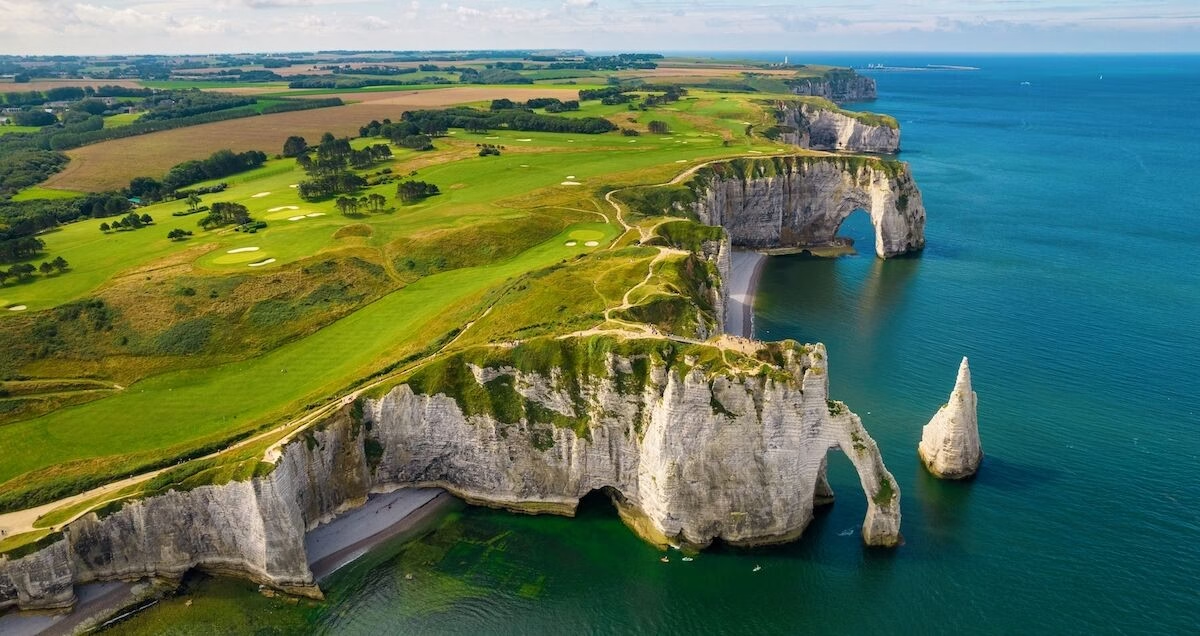
The world’s wealthiest travelers are quietly abandoning famous luxury hotspots in favor of secluded, low-visibility destinations that prioritize privacy, authenticity, and meaning. From remote Arctic regions to private African islands and culturally protected enclaves, these ten hidden destinations reveal where the ultra-rich are secretly booking this year—and why modern luxury now means being unseen.
Why Are the Ultra-Rich Avoiding Famous Luxury Destinations?
Luxury travel used to be about recognition. Today, it’s about avoidance.
For decades, the global elite followed predictable travel patterns—Monaco, Aspen, the Maldives, Saint-Tropez. But these destinations have become victims of their own success. Overcrowding, influencer saturation, paparazzi culture, and algorithm-driven tourism have stripped once-exclusive places of their appeal.
Modern ultra-high-net-worth individuals (UHNWIs) increasingly view visibility as a liability. Privacy breaches, social exposure, and crowds diminish the perceived value of even the most expensive resorts.
Real-world example: Private travel advisors report clients explicitly requesting destinations that “never trend” and asking for accommodations not listed on public booking platforms.
Luxury, today, is defined not by how famous a place is—but by how quietly it exists.
What Actually Makes a Destination “Hidden” for the Ultra-Rich?
A hidden destination isn’t necessarily unknown. It’s intentionally unoptimized for mass tourism.
These places typically feature:
- Geographic isolation or logistical complexity
- Limited accommodation capacity
- Cultural norms that discourage spectacle
- Minimal social media and influencer exposure
In short, they are destinations that resist virality.
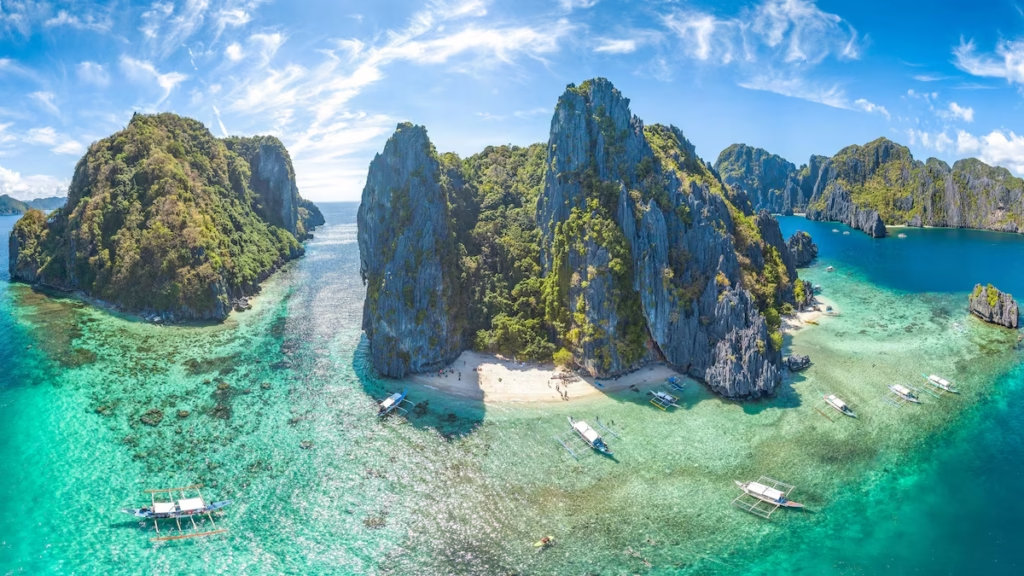
1. Why Are Billionaires Quietly Booking the Faroe Islands?
The Faroe Islands sit between Iceland and Norway, yet remain largely untouched by global tourism trends.
What draws the ultra-rich here is not luxury branding, but intentional restraint. There are no mega-resorts, no cruise ship crowds, and no nightlife designed for visitors. Instead, travelers encounter raw landscapes, small fishing villages, and deeply rooted Nordic traditions.
High-net-worth families often arrive via private aircraft or chartered connections, staying in architect-designed lodges or privately managed homes scattered across the islands.
Why the Faroe Islands appeal to elite travelers:
- Extremely low tourism density
- Natural beauty without commercialization
- Strong cultural identity and discretion
2. Why Are Patagonia’s Private Estancias in Such High Demand?
In Patagonia, the most exclusive experiences aren’t found in hotels—they’re found on private estancias.
These vast ranches span tens of thousands of acres across Argentina and Chile and are often family-owned, hosting only a handful of guests at a time. Days are structured around horseback riding, fly-fishing, glacier exploration, and evenings spent with local hosts rather than curated entertainment.
Real-world behavior: Ultra-wealthy families increasingly rent entire estancias for weeks, ensuring absolute privacy and personalized experiences.
What defines estancia luxury:
- Total seclusion
- One-to-one hosting
- Cultural immersion without performance
3. Why Is Lamu Island Becoming Africa’s Most Discreet Luxury Escape?
Off Kenya’s coast, Lamu Island offers a version of luxury that feels almost forgotten.
Cars are banned. Narrow alleyways wind through centuries-old Swahili architecture. Transportation happens by dhow or donkey. Luxury takes the form of restored historic mansions with inner courtyards, private staff, and ocean views.
Lamu attracts aristocratic European families, artists, and long-stay travelers seeking cultural depth and anonymity.
Why Lamu stands out:
- UNESCO-protected heritage
- No large-scale hotels
- Strong local respect for privacy
4. Why Are Ultra-Rich Travelers Choosing Greenland Over Antarctica?
Antarctica has become a bucket-list destination—and that’s precisely the problem.
Greenland, by contrast, remains vast, wild, and logistically demanding. In Greenland, luxury travelers book private fjord cruises, heli-skiing expeditions, and glacier treks guided by scientists.
Former Antarctica visitors increasingly describe Greenland as “what Antarctica used to be.”
Why Greenland appeals to the elite:
- Extremely low visitor numbers
- Monumental, untouched landscapes
- High logistical barriers that deter crowds
5. Why Is Albania Quietly Replacing the French Riviera?
The Albanian Riviera offers Mediterranean beauty without Mediterranean visibility.
Stretching along the Ionian coast, Albania delivers turquoise waters, dramatic cliffs, and historic towns—yet remains largely overlooked by mainstream luxury tourism.
High-net-worth Europeans are now quietly acquiring villas here, using Albania as a low-profile alternative to Monaco or Saint-Tropez.
Why Albania is gaining traction:
- Untouched coastline
- Low tourism saturation
- Emerging discreet luxury infrastructure
6. Why Is Raja Ampat the Most Exclusive Dive Destination on Earth?
Indonesia’s Raja Ampat is considered the most biodiverse marine region on the planet—yet sees remarkably few visitors.
Access requires multiple flights, permits, and coordination, creating natural friction that keeps mass tourism away. Luxury eco-resorts host fewer than 20 guests, many of whom are repeat ultra-wealthy visitors.
What makes Raja Ampat elite:
- Unmatched marine biodiversity
- Strict conservation practices
- Extreme remoteness
7. Why Do Billionaires Book Bhutan Years in Advance?
Bhutan intentionally limits tourism through daily visitor fees and controlled access. For the ultra-rich, this enhances the experience.
In Bhutan, luxury is centered on mindfulness, wellness, and spiritual depth rather than excess.
Many high-net-worth travelers return annually to the same lodge, valuing continuity and trusted relationships.
Why Bhutan remains exclusive:
- Cultural preservation over profit
- Minimal tourist volume
- Meaning-driven travel
8. Why Is Svalbard the Arctic’s Most Private Luxury Destination?
Deep inside the Arctic Circle, Svalbard offers polar nights, wildlife encounters, and profound silence.
Luxury here is subtle and intellectual—guided expeditions, scientific storytelling, and immersive wilderness experiences.
Who travels to Svalbard?
- Tech founders
- Climate philanthropists
- Privacy-focused elites
9. Why Are the Quirimbas Islands Becoming Private Family Retreats?
Mozambique’s Quirimbas Archipelago offers barefoot luxury rooted in conservation and community.
Some islands host just one lodge—or one family at a time. Guests engage with local fishing culture and marine protection initiatives.
Why families return:
- Extreme privacy
- Conservation-first philosophy
- Authentic East African heritage
10. Why Are Japan’s Setouchi Islands Attracting Discreet Elites?
Japan’s Setouchi region blends contemporary art, architecture, and natural beauty. Islands like Naoshima offer cultural sophistication without noise.
Luxury travelers appreciate Japan’s deep respect for discretion and limited accommodation supply.
Why Setouchi works:
- Intellectual and aesthetic appeal
- Quiet cultural tourism
- Low commercialization
How Do the Ultra-Rich Discover These Destinations?
Most do not rely on public search engines or social media.
Discovery happens through:
- Private travel advisors
- Family-office networks
- Invitation-only property access
Exclusivity is maintained through intentional invisibility.
Key Takeaways
- Luxury is shifting from visibility to privacy
- Remoteness now equals desirability
- Sustainability is a new status symbol
- The ultra-rich move early—before destinations trend
Frequently Asked Questions (FAQ)
1. Are these destinations open to regular travelers?
Yes, but access often requires planning, permits, and higher logistical effort.
2. Why is privacy now more important than luxury branding?
Crowds and exposure reduce perceived value for UHNW travelers.
3. Are these destinations safe?
Most are extremely safe due to low tourism density and strong local governance.
4. How far in advance are bookings made?
Anywhere from 6 months to 2 years for top properties.
5. Are private islands legal to own?
Yes, depending on local laws and conservation requirements.
6. Is sustainability really influencing wealthy travelers?
Yes, especially among younger billionaires and family offices.
7. Do celebrities visit these places?
Frequently—but rarely publicize it.
8. Are these destinations family-friendly?
Many are ideal for multi-generational travel.
9. Will these places become mainstream?
Some may, but early adopters move on quickly.
10. Is luxury travel becoming less flashy?
Absolutely. Quiet luxury now defines elite taste.




Leave a Reply