
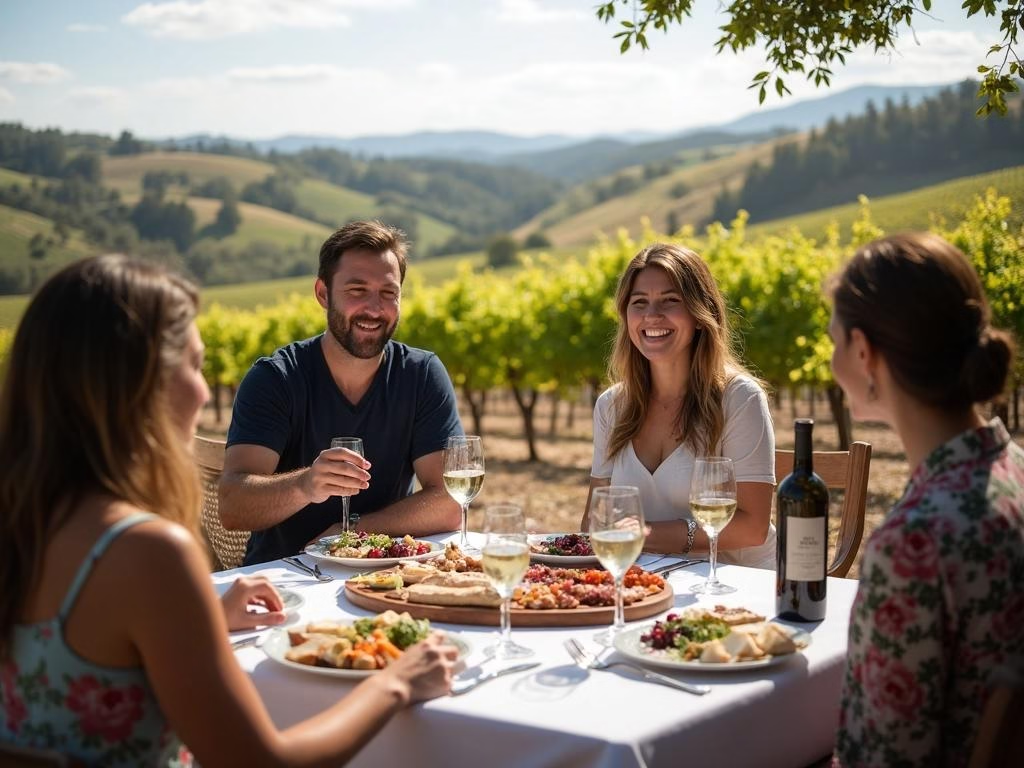
Food-centered travel in 2026 is becoming more intentional, local, and experience-driven. American travelers are planning trips around chef’s counters, regional tasting trails, farm dinners, food halls, cooking workshops, and restaurant reservations that reveal a destination’s identity. The appeal is practical as well as aspirational: better storytelling, stronger cultural context, memorable value, and experiences that often shape the trip more than a landmark or hotel.
American travel planning has changed in a visible way over the last few years: more itineraries now begin with the table. Travelers still care about beaches, museums, national parks, and hotel upgrades, but a growing share of trip decisions are being shaped by where to eat, what to taste, and how food can unlock a deeper understanding of a place. In 2026, that shift is no longer confined to luxury travelers or self-described “foodies.” It’s showing up in family trips, couples’ getaways, city breaks, and milestone vacations.
The broader numbers help explain why. The World Food Travel Association has long argued that food tourism is fundamentally about a “taste of place,” not simply restaurant hopping, and it estimates that travelers often spend about a quarter of their travel budgets on food and beverages. Grand View Research projects strong growth in the culinary tourism market, with the category expanding rapidly from its 2025 base into 2026 and beyond. Meanwhile, travel trend reporting across hospitality brands and travel publishers keeps pointing to the same conclusion: food is moving from a nice add-on to a primary planning factor for a large share of travelers.
That does not mean every traveler is chasing white-tablecloth tasting menus. In practice, the gourmet experiences Americans are prioritizing in 2026 are much broader and more grounded than that. They include chef-led dinners, yes, but also market tours, regional bakery crawls, vineyard lunches, oyster trails, omakase counters, fermentation workshops, destination food halls, and farm stays where the meal is inseparable from the landscape. What ties them together is not prestige alone. It’s the sense that the meal offers access: to local ingredients, local people, local craft, and a more memorable version of travel.
Why Gourmet Travel Is Becoming a Planning Priority Rather Than a Splurge
One reason gourmet experiences are gaining ground is that travelers are increasingly trying to make fewer, better decisions. Instead of packing a trip with loosely connected activities, many are choosing one or two anchor experiences and building the itinerary around them. A hard-to-book chef’s counter in Charleston, a vineyard lunch in Napa, a seafood tasting weekend in Maine, or a modern Mexican tasting menu in Mexico City can become the organizing principle for flights, hotel nights, and neighborhood exploration.
This reflects a larger shift in what people want from discretionary travel spending. A meal that tells the story of a region often feels more durable than another generic excursion. Travelers come home remembering the Appalachian trout course that referenced local smokehouse traditions, the New Orleans pastry class that explained the city’s French and Creole influences, or the Santa Barbara winery lunch where the winemaker and chef talked through drought, soil, and sourcing. The best gourmet experiences offer education, context, and sensory memory at the same time.
There is also a practical reason these experiences are worth planning around: they often help travelers avoid the “I went there but didn’t really experience it” problem. A thoughtful food experience naturally creates structure. It nudges visitors toward a neighborhood they might otherwise miss, introduces them to producers and staff who actually live the destination, and often leads to better adjacent choices—where to walk before dinner, which market to visit the next morning, which local products are worth bringing home, and which restaurants are genuinely distinct rather than merely well marketed.
For many Americans, gourmet travel in 2026 is also less about formal luxury and more about precision. People are asking better questions before they book: Is this experience rooted in the region, or could it exist anywhere? Is the price paying for quality and access, or mostly for theater? Is it appropriate for my trip style, budget, and travel companions? Those questions are pushing travelers toward experiences that feel specific rather than generic.
The Gourmet Experiences Travelers Are Prioritizing Most in 2026
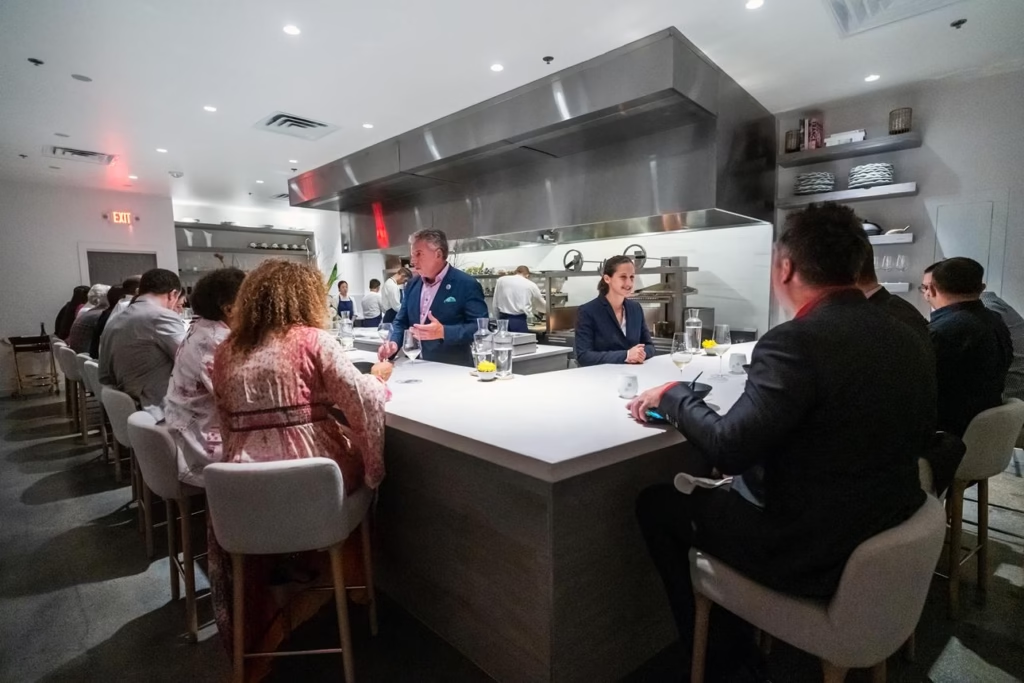
1) Chef’s counters and small-format tasting menus
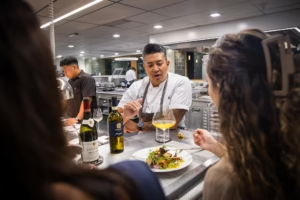
One of the clearest priorities in 2026 is the rise of intimate, chef-facing dining. Chef’s counters, omakase-style experiences, open-kitchen tasting rooms, and small tasting-menu formats appeal because they compress storytelling into a single evening. Travelers can watch technique, ask questions, learn about sourcing, and often get a more personal experience than they would in a larger dining room.
This format works especially well in cities where the restaurant scene is part of the destination’s identity. Think of a chef’s counter in New York focused on hyper-seasonal Northeastern ingredients, a seafood-forward tasting room in Seattle, or a modern Southern menu in Nashville that treats local produce and regional grains with the same seriousness once reserved for luxury imports. Michelin’s recent reporting on 2025 and 2026 food trends also points to elements that make these meals more compelling now: preserved and fermented flavors, cooking over fire, renewed tableside service, and more sophisticated nonalcoholic pairings.
For travelers, the value proposition is straightforward. A chef’s counter can replace a more scattered night of “maybe this bar, maybe that restaurant” with one highly intentional experience. It is often expensive, but it can also be efficient: dinner, entertainment, education, and a sense of place in one reservation.
2) Farm-to-table experiences that are actually tied to a farm
Travelers have become more skeptical of the phrase “farm-to-table,” and that skepticism is healthy. In 2026, the gourmet farm experiences people are prioritizing tend to be the ones where the agricultural side is visible and credible. That might mean a dinner on the property of a working farm, a stay at an inn with a serious kitchen garden, or a tasting menu that begins with a farm tour or a conversation about what is in season and why.
These experiences resonate because they connect food quality to landscape. They also appeal to travelers who want a slower pace without giving up culinary ambition. A well-run farm dinner in California wine country, the Hudson Valley, coastal Oregon, or rural Tennessee can satisfy several goals at once: a beautiful setting, a memorable meal, an educational component, and a more grounded sense of what the region grows well.
The sustainability angle matters too, but mostly when it is tangible rather than abstract. Travelers respond to seeing how a property handles compost, irrigation, regenerative practices, or heritage livestock far more than they respond to vague menu language. The meal feels more worthwhile when the story holds up under scrutiny.
3) Regional tasting trails built around one ingredient or food tradition
Another notable priority is the “food trail” approach: travelers building mini itineraries around oysters, barbecue, tacos, bagels, wine, bourbon, cheese, pastries, lobster rolls, or a city’s historic immigrant food traditions. These experiences are especially appealing to Americans because they combine flexibility with focus. You can structure a long weekend around three or four excellent stops without overcommitting to a single expensive reservation.
This format works in obvious destinations like New Orleans, Austin, Portland, Napa, Sonoma, Charleston, Chicago, and New York. But it is also increasingly relevant in smaller markets and second cities, where local tourism boards and independent operators are doing a better job packaging food culture as a reason to visit. The recent Michelin expansion into more U.S. regions is part of the same story: America’s culinary map is broadening, and travelers are being given new reasons to take secondary cities seriously as dining destinations.
The smartest version of a tasting trail is not just “eat a lot of one thing.” It’s a framework for understanding place. An oyster trail in coastal New England can teach travelers about salinity, aquaculture, and seasonality. A barbecue weekend in Texas can reveal regional distinctions in wood, smoke, cuts, and immigrant influence. A bakery crawl in Los Angeles can tell a story about Armenian, Mexican, Korean, Japanese, and classic American pastry traditions all within a few neighborhoods.
4) Food halls and chef collectives with genuine local identity
A few years ago, some travelers dismissed food halls as convenient but generic. In 2026, that view is less accurate. The better food halls now function as low-risk, high-reward entry points into a city’s dining scene. They allow travelers to sample multiple chefs or cuisines, adjust for different budgets and dietary preferences, and explore neighborhoods without committing to a long meal.
What makes them “gourmet” is not formality; it is curation. The best halls feature local operators with a clear point of view rather than a row of interchangeable fast-casual stalls. For a traveler trying to understand a city in one afternoon, a well-curated market or food hall can be one of the most efficient choices on the itinerary. It can also work as a strategic first-night meal, especially after a late arrival, when a traveler wants quality without the pressure of a two-hour dinner.
5) Wine-country meals that go beyond the tasting room
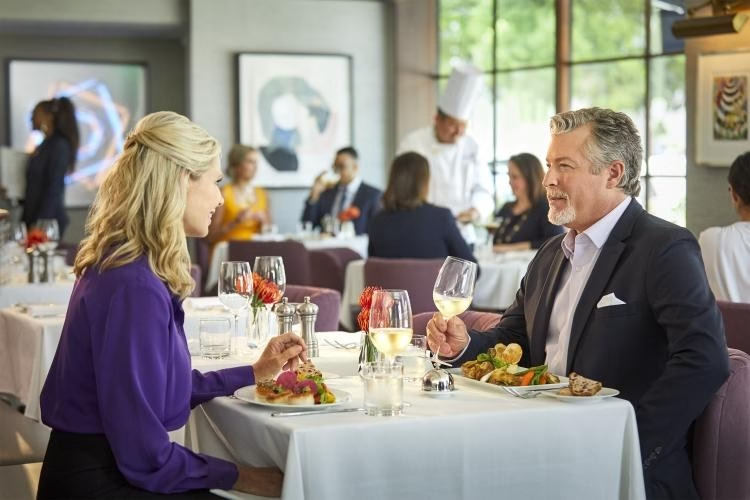
Wine-country travel remains a major draw, but the gourmet experiences gaining traction are not just standard tastings with cheese boards. Travelers are prioritizing vineyard lunches, chef collaborations, blending sessions, harvest dinners, and winery restaurants where the food is treated as seriously as the wine.
That distinction matters. A destination like Napa, Sonoma, the Willamette Valley, Santa Ynez, or Virginia wine country can feel repetitive if every stop offers the same format. A strong culinary component changes the equation. It encourages travelers to spend more time in one place, book lunch instead of rushing from tasting to tasting, and understand the relationship between the region’s agriculture and its hospitality culture.
There is also growing interest in nonalcoholic pairing programs, low-intervention wine education, and side-by-side tastings that explain how food changes the perception of a wine. For travelers who are curious but not expert, these formats make the experience feel inclusive rather than insider-only.
6) Hands-on classes that produce a better memory than another reservation
Cooking classes, pastry workshops, seafood shucking lessons, pasta-making sessions, coffee tastings, and fermentation labs are gaining favor because they convert a meal into a skill. Travelers increasingly want at least one experience they can partially take home, whether that means learning to make regional biscuits, understanding masa, rolling sushi properly, or building a spice blend from a market tour.
These experiences are particularly useful for families, couples, and multigenerational groups because they create participation instead of passive consumption. They also offer a practical hedge against restaurant fatigue. On a four- or five-day trip, not every meal needs to be a reservation marathon. A two-hour cooking class followed by lunch can be more memorable—and often more affordable—than another big dinner.
7) Grocery-store and specialty-market tourism
One of the more interesting developments in 2026 is the normalization of “grocery store tourism.” It sounds humble, but it speaks to a real desire: travelers want edible souvenirs, pantry insight, and a look at what locals actually buy. Recent trend reporting has highlighted strong interest in local grocery and pantry culture, especially among travelers who want food experiences that are immersive without being formal.
For gourmet travelers, the best version of this is strategic. It is not wandering a supermarket aimlessly. It is visiting a beloved Italian market in Boston’s North End, a Japanese grocery in Los Angeles, a specialty spice shop in New Orleans, a regional cheese counter in Vermont, or a premium food hall in Manhattan with a shopping list in hand. These visits help travelers understand a place at street level, and they often produce the most useful souvenirs: olive oil, tinned fish, spice blends, preserves, chocolate, coffee, or locally milled flour.
What Makes These Experiences Worth Planning Around
Not every expensive or attractive food event deserves centerpiece status in an itinerary. The gourmet experiences most worth planning around usually share five qualities.
- They are place-specific. If the menu, ingredients, or format could be transplanted anywhere with little loss, the experience may be good but not necessarily destination-defining.
- They offer context, not just consumption. A server, chef, sommelier, guide, or producer helps the traveler understand what they are tasting and why it matters locally.
- They create itinerary spillover. The meal naturally leads to other worthwhile stops: a market, neighborhood, producer, museum, shoreline walk, or scenic route.
- They are logistically realistic. The reservation time, location, pace, and price fit the rest of the trip rather than hijacking it.
- They match the traveler, not just the trend. A three-hour tasting menu may be perfect for one couple and entirely wrong for a family with two kids and a 7 a.m. flight.
In other words, the best gourmet experiences earn their place because they improve the trip around them, not just the meal itself.
How to Decide Which Gourmet Experience Deserves Your Time and Money
If you are planning a food-centered trip in 2026, it helps to treat gourmet experiences the way you would treat a major hotel booking or a premium excursion. A little evaluation up front can save money and disappointment later.
Start by asking what role the meal is supposed to play. Is it the trip’s marquee event, a relaxed lunch with a view, a family activity, or a way to understand a city quickly? A traveler who knows that distinction is less likely to overbook expensive dinners that all compete for the same emotional slot.
Then look for signs of substance. Menus that reference regional producers, seasonality, and local traditions tend to hold up better than menus that lean on luxury ingredients without much narrative. So do experiences with a visible educational component: chef interaction, a market guide, a winery host who can explain the site, or a class that connects ingredients to local history.
Reviews should be read carefully, but not obsessively. Instead of looking only at star ratings, scan for comments about pacing, hospitality, value, acoustics, and whether the experience felt rooted in the destination. A restaurant can be technically excellent and still be a poor fit for travel if it is too formal, too long, or too detached from place.
Finally, remember that gourmet travel does not need to mean constant spending. One of the most balanced approaches is to combine one anchor splurge with several lower-cost experiences that are equally revealing: a pastry crawl, a market lunch, a neighborhood wine bar, or a class. That mix often creates a richer trip than stacking multiple high-end dinners back to back.
Where American Travelers Are Looking in 2026
The demand pattern suggests a split between established culinary capitals and emerging or newly validated secondary cities. Travelers still gravitate to New York, Chicago, New Orleans, Charleston, Napa, Sonoma, Los Angeles, and Miami for obvious reasons. But they are also showing more interest in places where food scenes have matured without becoming fully saturated: Minneapolis, Detroit, Pittsburgh, parts of coastal New England, the Hudson Valley, Santa Fe, Portland, and select Southern and Midwestern cities.
What matters most is not whether a place is famous. It is whether the destination can offer a coherent food identity across several experiences: one strong dinner, one market or casual lunch, one local specialty worth chasing, and ideally one producer-facing activity such as a winery, farm, fishery, or cooking class. When a destination can deliver that mix, it becomes much easier to justify planning the trip around food.
Frequently Asked Questions
1) What counts as a gourmet travel experience in 2026?
It is broader than fine dining. A gourmet experience can be a chef’s counter, a winery lunch, a market tour, a farm dinner, a pastry workshop, an oyster trail, or a curated food hall visit—anything that offers exceptional quality plus meaningful connection to the destination.
2) Are gourmet trips only for luxury travelers?
No. Gourmet travel increasingly spans budgets. Many travelers mix one splurge reservation with lower-cost experiences like bakery crawls, food halls, market lunches, or hands-on classes.
3) How far in advance should I book a major food experience?
For high-demand restaurants, chef’s counters, and harvest dinners, booking two to eight weeks ahead is often wise, and longer for top destinations in peak season. More casual experiences can often be planned closer to departure.
4) What is a better value: one tasting menu or several casual meals?
It depends on your trip goals. If you want one memorable anchor experience with storytelling and service, a tasting menu can be worth it. If you want a wider survey of a city’s food culture, several casual meals may deliver more insight per dollar.
5) Are food halls worth including on a gourmet itinerary?
Yes, if the hall is locally curated and chef-driven. A strong food hall can provide range, flexibility, and neighborhood context without requiring a major time or budget commitment.
6) How do I tell whether a farm-to-table experience is genuine?
Look for visible sourcing details, seasonality, producer relationships, on-site agriculture, or staff who can clearly explain where ingredients come from and how the farm or kitchen operates.
7) Is Michelin recognition the best way to choose a food destination?
It can be helpful, but it is not the only useful signal. Regional specialties, local chef communities, market culture, and producer access often matter just as much as formal recognition.
8) What kinds of gourmet experiences work best for families?
Cooking classes, market tours, bakery trails, food halls, farm visits, and shorter tasting experiences usually work better than very long formal dinners.
9) How much of a travel budget should I expect to spend on food?
It varies by destination and travel style, but food is often a meaningful share of total trip spending. The World Food Travel Association has estimated that travelers commonly spend about 25% of their travel budget on food and beverages.
10) What is the biggest mistake people make when planning a gourmet trip?
Overbooking. Too many reservations can make a trip feel rigid and exhausting. A better strategy is to choose one or two anchor experiences and leave room for discovery.
Planning the Trip Around the Table, Not the Other Way Around
The gourmet experiences American travelers are prioritizing in 2026 are not just about prestige or indulgence. They reflect a more mature way of traveling—one that treats food as a reliable path into culture, geography, craftsmanship, and memory. A chef’s counter can reveal a city’s ingredients and ambitions. A farm dinner can explain a landscape. A bakery crawl can tell the story of migration and neighborhood change. A market visit can teach you what a destination values every day, not just on special occasions.
That is what makes these experiences worth planning around. They do not simply fill a mealtime slot. They improve the shape of the trip itself. When chosen well, they create structure, meaning, and a sense of local connection that is hard to replicate through sightseeing alone. For travelers who want their 2026 itineraries to feel more specific, more memorable, and more grounded in place, the smartest starting point may not be the hotel or the view. It may be the reservation, the market stall, the vineyard lunch, or the cooking bench that gives the destination its flavor.
If You’re Building a Food-First Itinerary This Year
- Choose one anchor gourmet experience per short trip rather than trying to make every meal a major event.
- Prioritize experiences that explain a region’s ingredients, history, or producers—not just its aesthetics.
- Use markets, bakeries, and food halls to add range and keep costs balanced.
- Read menus and reviews for signs of local identity, pacing, and service style.
- Match the dining format to the trip: chef’s counters for focused evenings, classes for participation, tasting trails for flexibility, and winery or farm meals for scenery plus substance.



Leave a Reply